Southern - Cantonese Opera
Chinese Opera can be traced back as far as the third century. There are variety art forms, and it generally classifies as Northern or Southern region. Beijing Opera considers as one of the most famous and notable art because of its association with the capital.
The plays of Chinese Opera cover a range of subject from comic to serious. Cantonese Opera, one of the major Southern Chinese Culture, is a tradition Chinese art form that associates with music, martial arts, and singing. Most of the Cantonese Opera plays tell stories about Chinese history, tradition, culture, and philosophies.
Unlike most of the European Opera, music does not play a main role in Cantonese Opera. Instead, lyric is considered the most essential part of the play. Writers tend to put words with same tune and melodies together. Singer in the play has the choice to add his or her own personal variation and style when they sing it.
In Cantonese Opera, there are two types of play, “Mo” and “Mun”. “Mo” means martial arts, and “Mun” means intellectual, polite, cultured. In general, “Mo” plays are stories about battles and warriors. It usually involves with action, using of weapons, and makeup for the characters are usually very complicated. “Mun” plays are stories about scholars, and royalty. They tend to be dramatic and the storyline goes slow and soft. Characters in this kind of play focus more on facial expression and tone of voice.
 |
| This is a "Mo" play that performed in Hong Kong back in 2006. Characters in this kind of play usually carry a long spear as their weapon. |
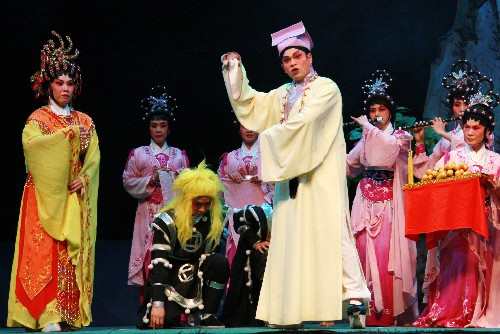 |
| This is a "Mun" play that performed in Guangzhou, China. Characters in this type of play do not carry any weapons, instead, they will show their abilities in *water sleeve* work. |
"The Lioness' Roar" is a well-known 30-scene comedy of the Ming Dynasty (1368-1644).
"The Lioness' Roar" is one of the most famous plays in the Cantonese Opera. The play tells about the story of Liu Shi, a jealous and abusive wife who never lets her husband, chen Jichang takes a concubine. Chen seeks help from his friends, judge, and the god in a shrine. Finally, he is rescued by the King of Hell, who puts Liu Shi in hell and torture her. Liu is eventually released by the King of Hell and she changes her behavior.
************************
*Water Sleeve - These are long pieces of white fabric that connected to the sleeves. Usually worn by both men and women in a "Mun" play. Actor or actress performs the waves and movements of the sleeve as softly and smoothly as water.
Works Cited
Cantonese Opera. Photograph. Guangzhou, China. Guangzhou China, Photos, Pictures,
Reviews. China Tour Gudie. Web. 27 Feb. 2012.
<http://www.chinatourguide.com/guangzhou/cantonese_opera.html>.
Fong, Stacey, and Erick Lee. "About Cantonese Opera." PearlMagik.com. 2002-2003 Bay Area
Cantonese Opera, 2002. Web. 27 Feb. 2012.
<http://www.pearlmagik.com/bayareacantoneseopera/aboutopera.htm>.
Felner, Mira, and Claudia Orenstein. The World of Theatre: Tradition and Innovation.
Boston: Pearson/Allyn & Bacon, 2006. Print
Hong Kong Picture Moments : Cantonese Opera Performers in Ting Kok Village, Tai
Po. 2006. Photograph. Hong Kong. ONE INCH PUNCH : East Asian Inspiration.
East Asian Inspiration. Web. 27 Feb. 2012.
<http://www.oneinchpunch.net/2007/03/30/hong-kong-picture-moments-cantonese-opera-performers-in-ting-kok-
village-tai-po/>.
20 July 2011. Web. 27 Feb. 2012. <http://www.youtube.com/watch?v=AMZSOMNqybM>.
