Monday, May 7, 2012

Clybourne Park


Clybourne Park is a very insightful play that reflects the discrimination issues happening in the past and in the present day. The performance should show the importance of the African-American history, as well as the American history. The colors of the stage and the costume should be between black and white in order to make a relatively contrast between the minority and the majority in the society.


Ken and Trisha Margeson Theatre 
The content of Clybourne Park is about prejudice and discrimination. The play involved with extreme social problems and issues, and because of that, it is directly targeted to elder and mature audiences that have highly and critical thinking skills. In order to particularly target to this kind of audiences, I would select the Ken and Trisha Margeson Theatre at the Orlando Shakespeare Theatre as the location of the performance. The theatre is located in the center of Orlando surrounded with colleges, schools, and businesses which gather many of the students and businessmen in the area. The theatre is fairly large that provides 324 seats for small amount of audiences to view the show quietly. The set up of the theatre also provides a pentagon shape stage that gives just enough space for the all settings and lighting.


The setting of the play should be a house with accessible view to each room; therefore the audience can see what each character is doing at any time. The house should be two-story high with a stair that can also view by the audience from every side of the theatre. There should only be one door for enter and exit purposes. The house, in the first act, should provide a setting that similar to the house in Chicago in 1959. The decoration in the house should reflect the family is wealth, middle class people. As well as in the second act, the house should also provide an idea that indicates the family is rich. The house doesn’t have to be changed too much since both acts are happening in the same house. However, the furniture and the decoration of the house have to be replaced with the style of present day. The house itself does not have to be symmetrical and the line should appear in curve which, in my opinion, represents the mystical of the play. The texture of the setting should be rough and uneven, helps reflecting the theme of discrimination in the play. Black, white, and grey should be the major colors of the setting because it provide a sense of sadness and hopelessness to the audience. All the elements should provide a vision that relates back to the discrimination problems that exist in both acts.


The costume of the play should indicate the wealth and the status of each character. In the first act, Francine and Albert should be wearing simple style and plain color clothing as a reflection of the minority of the society, and other characters should dress nice to show that they are the majority. However, in Act II, everyone should dress nice equally without anyone outstand others. The clothing should also change from the 19th style to the modern style.


The lighting of the play should create a mood of sadness. It should effectively indicate the time by using a dim and a brighter light. In the first act, the lighting should not be as strong as Act II. However, every time Russ talking in Act I, a bright light should be shined on him reflects that he is irritated and annoyed by the people that around him. And when Francine and Albert talking in Act I, no light or a darker light should shine on them to indicate that they are insignificant in the conversation and usually being ignored. In Act II, all the light should be stronger than what are used in Act I. The light can indicate that the time has changed as well as the story. It can also reflect that view of the discrimination issues in the society have also slightly improved. The technique of using darker light in Act I can also be used in Act II; however, the person should be changed. In the end of Act II, when Kenneth comes down from the stair, the light should only shine on him and Dan, who is reading the letter. The use of lighting in both Acts helps to indicate the importance and the significance of each character, which also helps to tell how the society has changed from time to time.


The sound of the play should be regarding to the topics and the themes, which are discrimination, bias, and prejudice. The background music should reflect the loneliness and the darkness of each character. The music that plays on the radio in the beginning of the first act should also parallel with the one that plays in the end of the second act. In addition, the music should be dark and mysterious in order to show how Kenneth is abandoned by the community.


Tuesday, April 10, 2012

Urinetown

     Performance Analysis


Urinetown is a tragicomedy musical. The characters in the show always empathize the performance is an alternative musical because everyone dies in the end of the show. There are few conflicts between the characters; however, the major conflict of the entire musical is between Bobby Strong and the Urine Good Company (UGC). Bobby is one of the leading characters. He works for Miss Pennywise as the assistant custodian of the public bathroom. Bobby represents the leader of freedom because eventually he will lead a revolution. In the other hand, Caldwell B. Cladwell, the president of UGC, represents the dictator of Urinetown. He sets up the fee for using public bathroom. In the musical, Bobby leads a rebellion against Penelope Pennywise and eventually against the UGC. Miss Pennywise is the person who lives to organize and maintain the public bathroom. In the musical, the turning point of the show happens after Bobby’s father, Joseph Strong, is sent to the no-man’s land – Urinetown. Bobby begins a “pee-for-free” rebellion with the people in the town when Cladwell’s assistant, Mr. McQueen announces the new public bathroom’s fee hikes. He realizes that the laws are wrong and decides to open up the door of the public bathroom and let everyone goes in and use for free. Cladwell eventually hears the news of the rebellion and decides to take action.  The climax takes place when Cladwell and the cops arrive and arrest Bobby. However, the number of the people stand on Bobby’s side outnumbered the number of cops. Bobby leads the people head to the hiding place, and the rebels capture Hope in the end of Act I. At the beginning of the Act II, Miss Pennywise searches and finds the hiding place and tells Bobby the Cladwell wants to meet him. Cladwell offers Bobby a large amount of money in the meeting; however, he refuses to take it. The resolution of the musical is when cops arrest Bobby and Miss Pennywise and send Bobby to “Urinetown”. In the meantime, Bobby learns the truth that there is no “Urinetown”. They just kill people. The cops throw Bobby off the building and he dies. His soul follows little Sally and speaks to her, encourages her to fight with what she believes. The final action is when Hope leads the rebellion, kills officer Barrel, Senate Finn, and Mrs. Millennium. After Hope takes over the UGC and renamed it as “The Bobby Strong Memorial Toilet Authority”, the crowd believes that their freedom has arrived. Nonetheless, as Officer Lockstock describes at the beginning, this is an alternative musical. Everyone in the town dies of thirst in the end because water supply disappears quickly.


The objectives of the musical are Bobby wants freedom and Caldwell wants to be rich. The subject of “Urinetown” is amenity. The idea of the musical is pursue your dream. The town is lack of water supply because of a twenty-year drought. The senate has to close down all the private bathroom and set rules like “pay-to-pee”. Bobby Strong completely thinks the law is wrong and begins a rebellion. He is a very strong and confident person who pursues what he thinks is right. We should learn his altitude and character, the way he fights for everything that happens in the musical. No matter how many obstacles and challenges we encounter, we should face it and fight for it and never give up.

Thursday, March 8, 2012

American Musical
                 From 1980s to 1990s


This is a poster that shows a scene in "The Black Crook".

American musical is a major form of musical theatre that combines with singing, dancing, and acting. It is a very famous and popular form of art that performs all over the world. Musical theatre has emerged and developed in the past 150 years in America. Some historian believes that "The Black Crook", written by an American playwright Charles Barras, is the first appearance of American Musical. 


A scene from Mariott Theatre's "Guys and Doll" in 2011.

Musical theatre is actually an offspring of Opera, and it's finally introduced in the western culture in the 19th century. American Musical covers a wide range of stories, from humor to love and anger. Even though American musical is a descendant of Opera, they are not completely in common. American musical focuses on spoken dialogues, dancing, uses of popular music at that time, and acting. Whereas singers in Opera only focus on singing, rarely need to dance.


A scene from Les Misérables, performed at the Queen's Theatre in  London.
In the 1980s and 1990s, European “mega-musicals” has influenced the entire American musical. Most of the performance featured with large casts and pop music. Still, the stories were continuingly based on novels and literatures. Les Misérables, a French novel that written by Victor Hugo, considered as one of the greatest novels of the 19th century. The show also became the longest-running international musical in the history.


Les Misérables 25th Anniversary, performing One Day More


A scene form Rent, a worldwide musical performance.
“Five hundred twenty five thousand six hundred minutes… How do you measure, measure a year?” You probably heard of this song, however, can not recall where it comes from. RENT, another popular Broadway show that appears in 1990s. Rent is based on La Bohème, an opera that based on Scènes de la vie de bohème by Henri Murger. The show is targeted to the younger audience and it is heavily involved with rock music. The story tells the life and struggles of a group of friends that living in New York. And because it is so inspiring and popular at that time, it turned into a worldwide musical show. The musical has been performed in 46 countries and in 24 different languages.


***Rent performing "Seasons of Love" on the Broadway.***


************************

Works Cited


Abarbanel, Jonathan. "Mr. Producer: Hang up Sondheim for a Weill." WBEZ. 11 Jan. 2012.
        Web. 08 Mar. 2012. <http://www.wbez.org/blog/onstagebackstage/2012-01-11/mr-
        producer-hang-sondheim-weill-95451>.


Barras, Charles M. "The Black Crook: Sample Scene." Musicals101.com. Musical 101.
        Web. 08 Mar. 2012. <http://www.musicals101.com/blackcrook.htm>.


Cohen, Robert. "The Musical Theatre." Theatre, Brief Version. 6th ed. New York:
        McGraw-Hill Humanities/Social Sciences/Languages, 2002. Theatre, Brief
        Version. McGraw-Hill Humanities/Social Sciences/Languages, 20 Jan. 2002. Web. 08
        Mar. 2012. <http://highered.mcgraw-hill.com/sites/0767430077/student_view0/chapter9/>.


Kenrick, John. "A History of the Musical What Is A Musical?" Web log post. Musical
        101.com. Muscial 101, 1996. Web. 8 Mar. 2012.
        <http://www.musicals101.com/musical.htm>.


One Day More - Les Miserables 25th Anniversary. By Victor Hugo. Perf. Alfie Boe and
       Jenny Galloway. YouTube. YouTube, 31 Mar. 2011. Web. 08 Mar. 2012.
       <http://www.youtube.com/watch?v=BpGA_VRc1Ro>.


"Rent Musical â History." Rent Musical – History. Rent Musical. Web. 08 Mar. 2012.
       <http://www.rentmusical.net/history>.


Rent - Seasons of Love. By Jonathan Larson. Perf. Adam Pascal and Daphne Rubin-Vega.YouTube.
      YouTube, 03 Mar. 2009. Web. 08 Mar. 2012.
      <http://www.youtube.com/watch?v=djWlhlkEOPQ>.


Rust, Jennifer. "Rent: An American Musical." Web log post. AngelFire. AngelFire. Web.
      8 Mar. 2012. <http://www.angelfire.com/hi2/42ndstreet/rentshow.html>.

Monday, February 27, 2012

Chinese Opera
        Southern - Cantonese Opera


Chinese Opera can be traced back as far as the third century. There are variety art forms, and it generally classifies as Northern or Southern region. Beijing Opera considers as one of the most famous and notable art because of its association with the capital. 


The plays of Chinese Opera cover a range of subject from comic to serious. Cantonese Opera, one of the major Southern Chinese Culture, is a tradition Chinese art form that associates with music, martial arts, and singing. Most of the Cantonese Opera plays tell stories about Chinese history, tradition, culture, and philosophies


Unlike most of the European Opera, music does not play a main role in Cantonese Opera. Instead, lyric is considered the most essential part of the play. Writers tend to put words with same tune and melodies together. Singer in the play has the choice to add his or her own personal variation and style when they sing it.

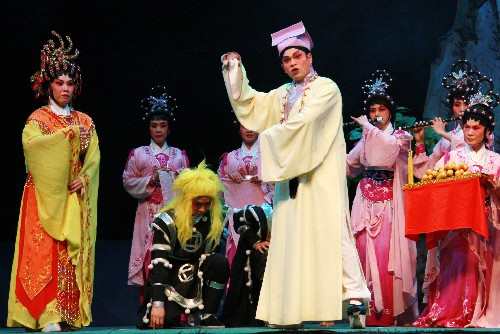
In Cantonese Opera, there are two types of play, “Mo” and “Mun”. “Mo” means martial arts, and “Mun” means intellectual, polite, cultured. In general, “Mo” plays are stories about battles and warriors. It usually involves with action, using of weapons, and makeup for the characters are usually very complicated. “Mun” plays are stories about scholars, and royalty. They tend to be dramatic and the storyline goes slow and soft. Characters in this kind of play focus more on facial expression and tone of voice.


This is a "Mo" play that performed in Hong Kong back in 2006.
Characters in this kind of play usually carry a long spear as their weapon.


This is a "Mun" play that performed in Guangzhou, China.
Characters in this type of play do not carry any weapons, instead,
 
they will show their abilities in *water sleeve* work.


"The Lioness' Roar" is a well-known 30-scene comedy of the Ming Dynasty (1368-1644).


"The Lioness' Roar" is one of the most famous plays in the Cantonese Opera. The play tells about the story of Liu Shi, a jealous and abusive wife who never lets her husband, chen Jichang takes a concubine. Chen seeks help from his friends, judge, and the god in a shrine. Finally, he is rescued by the King of Hell, who puts Liu Shi in hell and torture her. Liu is eventually released by the King of Hell and she changes her behavior.


************************
*Water Sleeve - These are long pieces of white fabric that connected to the sleeves. Usually worn by both men and women in a "Mun" play. Actor or actress performs the waves and movements of the sleeve as softly and smoothly as water.


Works Cited

Cantonese Opera. Photograph. Guangzhou, China. Guangzhou China, Photos, Pictures, 
         Reviews. China Tour Gudie. Web. 27 Feb. 2012.                                           
         <http://www.chinatourguide.com/guangzhou/cantonese_opera.html>. 

Fong, Stacey, and Erick Lee. "About Cantonese Opera." PearlMagik.com. 2002-2003 Bay Area          
         Cantonese Opera, 2002. Web. 27 Feb. 2012. 
         <http://www.pearlmagik.com/bayareacantoneseopera/aboutopera.htm>.

Felner, Mira, and Claudia Orenstein. The World of Theatre: Tradition and Innovation. 
       Boston: Pearson/Allyn & Bacon, 2006. Print

Hong Kong Picture Moments : Cantonese Opera Performers in Ting Kok Village, Tai 
         Po. 2006. Photograph. Hong Kong. ONE INCH PUNCH : East Asian Inspiration. 
         East Asian Inspiration. Web. 27 Feb. 2012. 
        <http://www.oneinchpunch.net/2007/03/30/hong-kong-picture-moments-cantonese-opera-performers-in-ting-kok-
        village-tai-po/>.

The Lioness Roars: A Cantonese Opera. Dir. SupremeMasterTV13. YouTube. YouTube, 
       20 July 2011. Web. 27 Feb. 2012. <http://www.youtube.com/watch?v=AMZSOMNqybM>.